
Role Intelligence: Inside the New Chief AI Officer Mandate
Welcome to Searchlight—a briefing on executive leadership trends and insights shaping the future of professional services and private equity, presented by Beecher Reagan and Kinavic Leadership Acceleration.
Together, Beecher Reagan and Kinavic form a strategic talent platform that helps leading professional services and private equity firms identify, select, and accelerate the performance of executive talent to enable growth.
Recent Executive Searches We've Completed
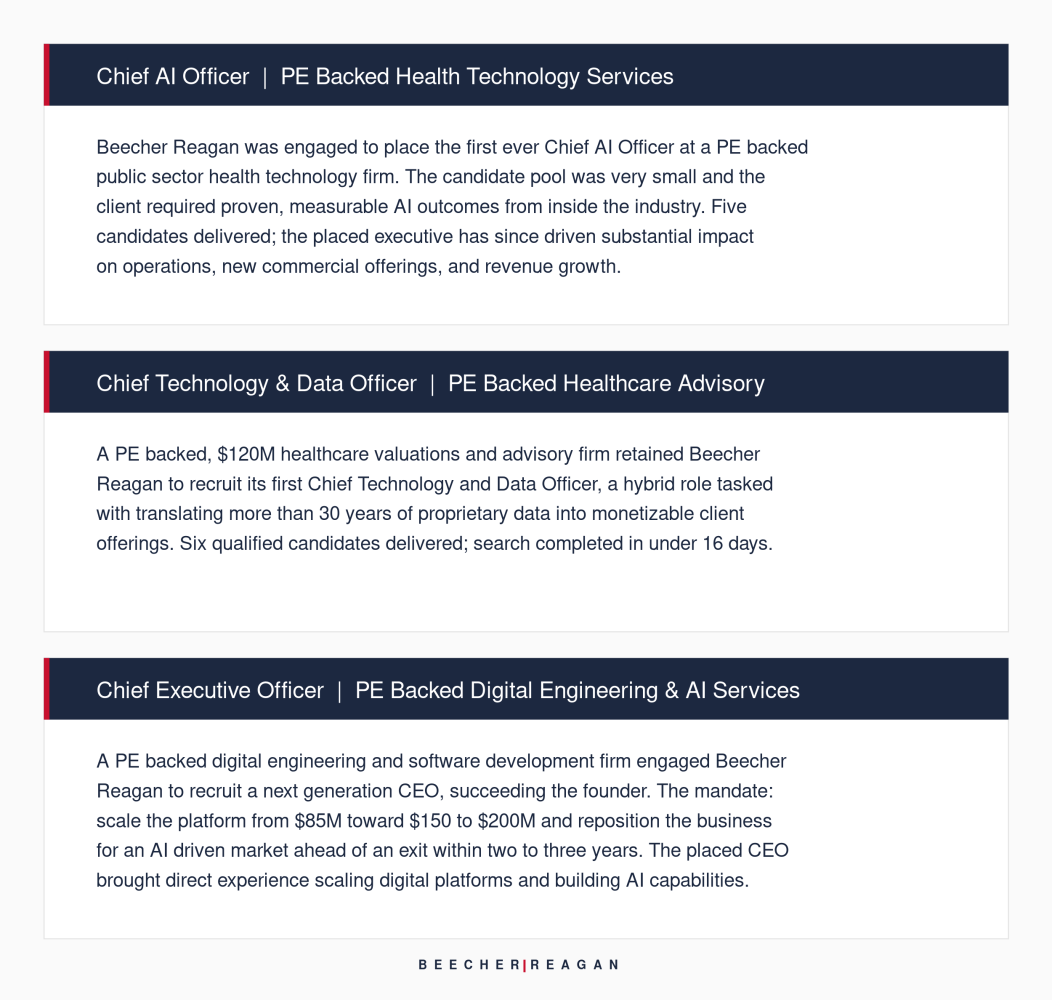
Want to discuss your next search for executive leaders who can navigate disruption and drive growth? Get in touch with us to book a strategy call today.
Professional services Executive Talent Trends & Insights
Role Intelligence: Inside the New Chief AI Officer Mandate
From Clark R. Beecher, Managing Partner, Beecher Reagan
Five years ago, if a PE-backed services firm called us about an "AI role," it was usually an addition to the CIO's org chart. A capability hire. Maybe a Head of Data with an AI flavor.
That has changed.
What we are being asked to find now is a different role entirely, and most of the firms writing the job spec are still describing the old one.
Here is what the new mandate actually looks like, pulled from the Chief AI Officer searches we have run over the last 24 months for PE sponsors and PE-backed services firms.
1. It is a commercial role, not an R&D role.
The Chief AI Officer is being hired to translate AI into revenue. Not capability. Not innovation in the abstract. Revenue, margin, and growth, measured the same way every other commercial bet in the business is measured.
The leaders who succeed are building client-facing products and services powered by AI. They are activating data the firm already owns into commercial offerings. They are being held to ROI on the same cycle as the Chief Revenue Officer.
If the spec reads like an R&D charter, we are looking for the wrong person.
2. It is a builder mandate, not an operator one.
Almost every Chief AI Officer search we are running today is a first-of-its-kind hire at the company.
That means defining the function from scratch. Org structure, operating model, what is centralized versus embedded, how it ties into the executive team. There is no existing AI function to inherit. The person in the seat has to build one.
Frankly, this is where most candidates wash out. There is a category of senior AI leaders who have only ever operated inside an existing function. They have never stood one up. The interview goes well. The first 90 days do not.
3. The hybrid is what we are being asked to find.
The market is split between AI-native-talent (deep technical depth, often from the model labs) and AI-enablement-talent (business translation, commercial chops, often ex consulting).
Firms are explicitly hiring for the translator gap.
The candidates clients fall in love with are the ones who can sit at the executive table, defend a revenue projection in front of the board, and then walk into engineering and explain why the model architecture matters. That is a rare profile. It is not a CIO. It is not a CTO.
And it is increasingly being elevated to a peer C-suite seat, not buried under IT.
4. At the fund level, the mandate is portfolio-wide.
The role looks different again at the sponsor. Operating Partners with AI mandates are being asked to enable AI across multiple portfolio companies, driving value at scale across the investments, not just inside one.
That is a different spec entirely, and we source for it differently. The candidate pool is small. The bar for prior outcomes is high. Pedigree alone does not clear it.
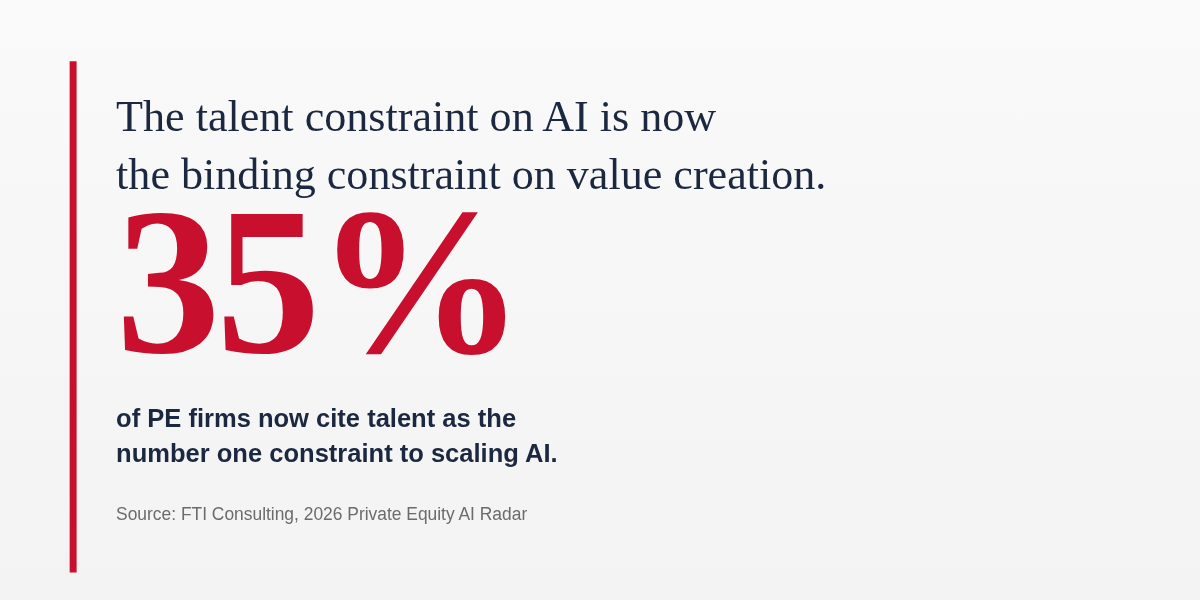
5. The candidate pool is small. The clock is short.
These searches come with urgent timelines tied to strategic initiatives. A launch. An integration. A value creation milestone. There is no time for developmental talent. Firms are asking us for experienced operators who can execute immediately and who can point to measurable outcomes from prior roles.
That last part matters more than ever. Demonstrated outcomes are clearing the bar, but conceptual thinking is not. The strongest candidates we present have actually shipped commercial AI into a business and watched it move the P&L.
If you are scoping a Chief AI Officer or AI leadership search, at the fund level or at a portfolio company, we are in the middle of several of these right now and have a strong read on what is working. Get in touch with me directly or reach out on our site, and we will set up a call.
— Clark R. Beecher, Managing Partner, Beecher Reagan
content catch-up
Accelerating Value Creation Through Leadership: Putting Hard Numbers on the Soft Stuff
PE deal teams run a "leader's recon" on every input to a deal: market, commercial, financial, legal, and technology. On the one input most likely to determine the outcome, the leaders who execute the value creation plan, most firms still operate on relationships and gut feel.
Kinavic Leadership Acceleration Senior Partner Nate Boaz makes the case for a multi-factor, future-focused approach to talent diligence and lays out the four-factor model Kinavic uses across PE-backed professional services engagements (90% retention of key leaders, accelerated value creation versus plan, 21% margin improvement post transition in one global transformation).
Together, Beecher Reagan and Kinavic form a strategic talent platform that helps leading professional services and private equity firms identify, select, and accelerate the performance of executive talent to enable growth.
Whenever you're ready, here's how we can help your organization:
Get in touch with a Beecher Reagan Partner today to discuss identifying and hiring your next resilient leader to navigate disruption and drive growth.
Contact Kinavic Leadership Acceleration to discuss how to predict and accelerate the performance of your Partners and executive leadership.